



Welcoming a litter of newborn puppies into the world is an exciting experience for any dog owner or breeder. One of the most anticipated moments is when those tiny, sealed eyelids finally part, revealing curious eyes ready to explore. But puppy eye development is just one piece of a larger puzzle in early canine growth. In this in-depth article, we’ll explore everything from why puppies are born with closed eyes to full puppy development stages, including physical changes, behavior shifts, health care tips, nutrition, training, and socialization. Whether you’re searching for when do newborn puppies open their eyes or wondering about related milestones like ear opening and walking, we’ve got you covered with insights drawn from veterinary experts and top resources.
When Do Puppies’ Eyes Develop?
Puppy eye development begins in the womb around four weeks of gestation, but it’s far from complete at birth. At this stage, the eyes are fragile structures, with the optical nerves and retinas still forming. Puppies are born with their eyelids fused shut to protect these sensitive components from light, dirt, and potential infections during the birthing process. This sealed state allows the eyes to mature safely in a dark, controlled environment.
Prenatal Development
Eyes start forming in utero, with basic structures like the retina and optic nerve developing by week four of gestation. Maternal nutrition, including DHA, supports this early growth.
Postnatal Maturation
After birth, the iris begins producing melanin, initially giving eyes a hazy blue-gray appearance. Full visual acuity develops by about eight weeks as nerves refine.
Breed Variations
Smaller breeds like Chihuahuas may experience delayed development—up to 16-17 days—while larger breeds often progress faster.
Key factors affecting eye development include genetics, maternal health, and environmental conditions. Ensuring the mother dog receives proper prenatal nutrition, such as DHA-rich foods for brain and eye support, can optimize this process.
Why Are Puppies Born With Their Eyes Closed?
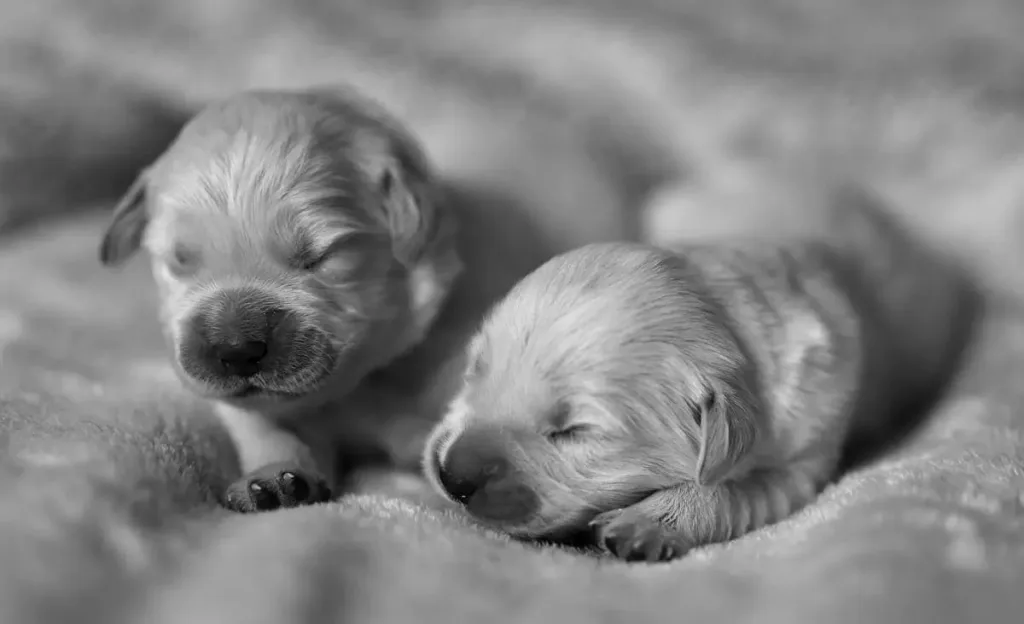
Puppies are altricial animals, meaning they’re born in an underdeveloped state compared to precocial species like horses, which can walk shortly after birth. This evolutionary trait stems from dogs’ wild ancestors, like wolves, who needed short gestation periods (about 60–63 days) to allow mothers to hunt and protect the den quickly. Closed eyes shield the immature optical system from bacteria, debris, and bright light that could cause permanent damage.
- Evolutionary Protection: Short gestation ensures survival in the wild but leaves senses underdeveloped at birth.
- Infection Prevention: Sealed eyelids act as a barrier against environmental hazards during delivery.
- Sensory Prioritization: Newborns rely on smell and touch for nursing, delaying sight until they’re stronger.
Without this protection, exposure during birth could lead to infections or impaired vision. In essence, nature prioritizes survival by delaying eye opening until the puppy is stronger and less vulnerable.
When Do Newborn Puppies Open Their Eyes?
Most newborn puppies open their eyes between 10 and 14 days after birth, though this can vary from 5 to 21 days depending on breed and individual health. It’s common for one eye to open before the other, sometimes over a few days. Smaller breeds might take longer, up to 16–17 days, while larger ones often hit the milestone earlier.
At opening, the eyes appear cloudy or milky blue due to incomplete development. Never force them open—this can cause injury or infection. If eyes remain closed past 16 days, consult a veterinarian to rule out issues like fused eyelids or congenital defects.
What Happens When Puppies Open Their Eyes?
The moment puppies open their eyes marks a surge in exploration and sensory integration. Initially, vision is blurry and limited to about a foot away, detecting only shapes, movement, and light contrasts. They become more responsive to their environment, starting to recognize littermates and their mother through a combination of sight and smell.
- Sensory Awakening: Eyes opening coincides with increased curiosity and interaction with surroundings.
- Social Bonding: Puppies start forming stronger connections with littermates and mom.
- Mobility Boost: This phase aligns with early walking attempts, enhancing exploration.
This phase coincides with increased mobility—puppies begin crawling more purposefully around 7–14 days and may attempt wobbly steps by day 16. Social bonds strengthen as they interact with siblings, laying the foundation for pack behavior. Owners should keep the whelping area dimly lit to protect sensitive eyes from bright light.
What Can a Puppy See After Opening Their Eyes?
Right after opening, a puppy’s vision is poor—blurry and sensitive to light, with a hazy blue tint. They can detect motion and basic shapes but not fine details. Puppies see in shades of blue and yellow (dichromatic vision), excelling in low light thanks to more rods in their retinas and a tapetum lucidum layer that reflects light. Full color perception and sharpness develop by about eight weeks.
- Initial Capabilities: Limited to detecting movement and contrasts within close range.
- Color Vision: Sees blue and yellow hues; fewer cones than humans.
- Low-Light Advantage: Better night vision due to retinal structure.
How Much Can Puppies See?
Early vision is limited: puppies see best in dim conditions and are motion-sensitive, aiding their hunter heritage. By 3–4 weeks, they can track objects like a rolling cotton ball, indicating basic sight. Depth perception and focus improve gradually, reaching adult levels around 8–10 weeks. Unlike humans, dogs prioritize movement over color, seeing fewer hues but better in the dark.
- Range and Clarity: Blurry beyond a foot initially; sharpens over weeks.
- Motion Detection: Excel at spotting moving objects, a survival trait.
- Comparison to Adults: Full acuity by 8 weeks, but always motion-focused.
When Do Puppies Start Walking and Opening Their Eyes?
Puppies typically open their eyes around 10–14 days, aligning with the start of walking attempts. They begin crawling at 7–14 days and achieve a wobbly gait by 18–21 days. By 3–4 weeks, they’re more steady, exploring their surroundings as vision sharpens. This transitional stage (2–4 weeks) sees rapid motor development, with baby teeth emerging and senses awakening.
- Timeline Integration: Eyes open (10–14 days) just before or with first steps (16–21 days).
- Breed Differences: Larger breeds may walk earlier; smaller ones take longer.
- Supportive Care: Provide safe spaces to practice without hazards.
What to Do After Puppies Open Their Eyes

Once eyes open, prioritize gentle care: clean any discharge with a warm, damp cotton ball and keep the area dimly lit. Introduce soft stimuli like household sounds to aid socialization. Monitor for infections—swelling or pus warrants a vet visit. Start weaning around 3–4 weeks with puppy mush, and begin basic handling to build trust.
- Eye Care: Gently wipe discharge; avoid bright lights to prevent discomfort.
- Environmental Enrichment: Gradual exposure to sounds and textures.
- Health Monitoring: Check for even development among littermates.
- Weaning Introduction: Mix milk with softened kibble for transition.
When Do Puppies’ Eyes Change Color?
Puppies’ eyes start as blue-gray and begin changing around 3–4 weeks as melanin accumulates. Most settle into their adult color (usually brown, amber, or hazel) by 9–16 weeks, though some take up to six months. Breeds like Huskies or Merles may retain blue eyes or develop heterochromia. Albinism can result in red or pink eyes.
- Process: Melanin buildup shifts from blue to permanent hue.
- Variations: Genetic factors influence final color; some breeds keep blue.
- Timeline Variations: Full change by 4–6 months in most cases.
Why Are Puppies Born With Their Ears Closed?
Like eyes, ears are sealed at birth to protect developing structures from infection and pressure changes. This allows safe maturation in utero and during birth.
- Protective Mechanism: Shields inner ear from debris and bacteria.
- Evolutionary Adaptation: Aligns with short gestation for survival.
When Do Puppies Open Their Ears?
Ears typically open around 12–14 days, shortly after eyes. Hearing refines by 5–8 weeks. Puppies hear higher frequencies than humans, aiding in early communication.
- Development: From muffled sounds to full range by 5 weeks.
- Capabilities: Detects up to four times the human range, including ultrasounds.
When Should You Worry About Your Puppy’s Development?
Monitor milestones closely: eyes and ears should open by 16–21 days; walking by 3 weeks. Worry if there’s lethargy, poor weight gain, swelling, discharge, or uneven development. Fear periods (8–11 weeks and 6–14 months) can cause temporary anxiety—handle with positive reinforcement. Vet checks are essential for early detection.
- Red Flags: Delayed openings, asymmetry, or lack of response to stimuli.
- Growth Issues: Slower weight gain or mobility compared to littermates.
- Behavioral Signs: Excessive fear or withdrawal during key periods.
Puppy Development Stages
Puppies progress through distinct stages from birth to adulthood.
Physical Development
- Neonatal (0–2 weeks): Eyes/ears closed; rely on mom for everything; crawling begins.
- Transitional (2–4 weeks): Eyes/ears open; first steps; teeth emerge; weaning starts.
- Socialization (3–12 weeks): Full senses; rapid growth; baby teeth complete.
- Juvenile (3–6 months): Teething; fear periods; sexual maturity begins.
- Adolescence (6–18 months): Full size; energy peaks; adult teeth in.
Behavior Changes
Puppies shift from dependence to independence. Fear periods cause sudden wariness—counter with exposure.
- Early Weeks: Sleep and eat focus; minimal interaction.
- 3–8 Weeks: Exploration, play, and learning social cues.
- Fear Periods: Temporary caution; use positive experiences.
- Adolescence: Boundary testing; increased energy and independence.
Health and Care
Regular deworming and vaccinations start at 6–8 weeks. Watch for infections; provide clean, warm environments. Eye care includes gentle cleaning; address vision issues early.
- Vaccinations: Core shots at 6–8 weeks; boosters follow.
- Parasite Control: Deworm every two weeks initially.
- Environment: Warm, draft-free whelping box; monitor temperature.
- Vet Visits: Weekly weigh-ins; immediate if issues arise.
Food and Nutrition
Start with mother’s milk; introduce solids at 3–4 weeks. Puppy food rich in protein, DHA, and calcium supports growth.
- 0–3 Weeks: Exclusive nursing or formula.
- 3–8 Weeks: Weaning with mush; transition to kibble.
- Nutrients: DHA for eyes/brain; protein for muscles.
- Frequency: Small, frequent meals to prevent hypoglycemia.
Training and Socialization
Begin crate training at 3–4 weeks; socialize from 4–12 weeks to prevent fears. Positive reinforcement builds confidence.
- Early Handling: Gentle touch from 3 weeks.
- Social Exposure: People, sounds, surfaces from 4–12 weeks.
- Basic Training: Potty, crate from 4 weeks.
- Ongoing: Obedience classes post-vaccination.
Frequently Asked Questions:
Do all puppies have blue eyes at birth?
Yes. Most puppies are born with blue-gray eyes, but the color typically shifts to brown or amber by about 16 weeks.
What if one eye opens first?
That’s perfectly normal. The other eye usually follows within a couple of days.
Can puppies see color?
Their color vision is limited to shades of blue and yellow, but they have excellent low-light vision.
When do puppies hear fully?
Puppies develop full hearing between 5 and 8 weeks of age.
How can I test a puppy’s vision?
Gently toss a soft cotton ball a few feet away. If the puppy tracks the movement, their sight is developing well.
Summary
Puppies typically open their eyes around 10–14 days after birth, signaling the start of a fascinating growth journey. From fragile newborns to playful explorers, understanding key milestones—such as eye and ear opening, first steps, and eventual eye-color changes—helps ensure the best care.
Address breed variations and developmental stages proactively, provide balanced nutrition, and focus on early socialization. With regular veterinary checkups and a nurturing environment, your puppies will grow into healthy, happy adult dogs.